Hello.
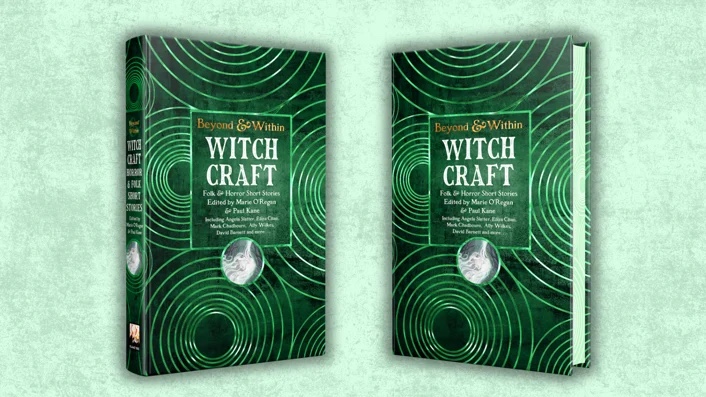
So, I’m writing again. And it’s going to be a busy year as a result. I’ve already had one story, “The Tallow Feast,” released in Flame Tree Press’s Witchcraft—edited by the amazing Marie O’Regan and Paul Kane—and there are at least three more publications in the pipeline for 2026. The first of them, I’m delighted to say, is for the inaugural issue of Sci-Fi Ireland. We’ve been sorely in need of just such a publication on this island, so I’m incredibly proud to be part of the launch of what I hope will be a major venue for Irish speculative fiction. My story is called, “Lazarus Rising,” and it’s kind of a near-future take on body horror, but in a bloodless way. I’m excited for people to read it, and I hope to do a reading of it myself at Norncon in Belfast this May 9th, where Sci-Fi Ireland will launch officially.
To relaunch my website, however, I’ve decided to go back to the start of my writing journey and root out my first published story, “Intervention Paradox.”
This story is my only other science fiction work, and it won the Octocon Short Story Prize in 2011, as chosen by esteemed judge, Peadar Ó Guilín, author of The Call, The Invasion, and The Bone World Trilogy. Peadar went on to help me refine and improve this story for its ebook release, and he continues to be a kind supporter of my writing today. His latest novel, The Sword Garden, can be found here.
I’m going to be reposting a series of my previously published pieces, to get this place going; revisiting the milestones that taught me what my voice was, to help me find it again for this next part of the journey. Like “Intervention Paradox,” these stories all ended up being collaborations with amazing editors and writers, and I like the idea that I can thank those people for helping me learn to write as I revisit the stories we worked on together.
This, then, is
Intervention Paradox
“ONE OF THEM is going to kill me?”
“Yes.”
“One of my own family?”
Cullen set the deck of cards he’d been playing with back down in front of him. Vincent was glad: watching the man sliding two and then three different cuts of the deck over and under each other with one hand had been leaving him cross-eyed.
“It’s called the Intervention Paradox. It’s like, one of the first long cons a hustler picks up after learning the short stuff…the Quantum Lady, say, or the Precog,” Cullen said. “It’s the knowing that they’re going to kill you that makes you do the stupid shit that actually leads to them killing you. Or causing your accident, whatever. See? Now, professors will tell you that intentionally changing a future event in that way is impossible. That’s ‘coz professors are full of crap. Not that I don’t love them for it; it’s people like them, saying what they say, that makes the likes of the Intervention Paradox such a profitable con.” Cullen fixed Vincent in the eye. “Believe me, you’re being hustled, Vinnie. Or you would have been, without me.”
Cullen went back to his fries while Vincent lost all appetite. He kept losing things today. In his fifty two years, he’d rarely lost so much as a paper clip or stray coin. But in the half-hour he’d known Gabriel Cullen, Vincent had lost both his job and his faith in reality, and was set to lose his family and his life on top of that. And all in a matter of, what—hours? Maybe minutes, if Cullen was to be believed. All lost: unless he did what Cullen said.
“So, as long as I don’t fall for the con—”
“No. You don’t get it. It’s not a ruse, Vinnie, you’re not being tricked. These guys aren’t parlour magicians at a kid’s party. Now that you know—it’s gonna happen. We live in a block universe, Vinnie, the past and future coexisting in space-time. You need to study your Einstein. These are absolute, not potential futures.”
“Why tell me, then?” Vincent snapped at the hustler.
“It was going to happen—I’m just getting in first, Vinnie. That’s for your benefit.”
“Yeah? Or you’re behind it.”
Cullen smiled.
“I won’t say double-bluffing doesn’t come with the territory, but if I was the guy—and I’m not—why would I make this any more complex than it needs to be? Why mention a scam at all, eh? Why give you any more reason to doubt what I’m telling you?”
“I dunno,” Vincent said, crossing his arms and slamming himself back into the leather upright of the booth they were occupying. He kept looking at the door, half expecting his wife to wander in, coincidentally carrying a bag full of knives. He pushed his coffee away.
“The challenge, I suppose…” Cullen said moments later.
“What?”
“I was just thinking out loud,” Cullen continued. “Answering my own question—why mention the scam? It just occurred to me that the challenge might be worth it. Load the deck against myself, yet still take the pot, you know?”
Vincent stared at him, teeth working back and forth.
“You’re not going to die, Vinnie.”
“You just said I would. Absolute future, you said.”
“I also said that calling changing the future impossible was crap. You have nothing to worry about, believe me.”
There was no believing Gabriel Cullen: the man was unbelievable. He did unbelievable things. He’d introduced himself to Vincent that morning by walking through a solid brick wall as if it wasn’t even there and interrupting a sales presentation. Then he’d launched into his own pitch about preventing Vincent’s death as if the other people in the room weren’t there either. More disturbing again, however, was when they’d reacted in just the same way about Cullen. As soon as Vincent realised that his conversation with the imaginary man was causing his colleagues no small amount of distress, and that he was obviously having some kind of psychotic episode, he’d immediately quit his job. Later, of course, as they’d walked together into the diner and the waitress and short order cook alike had both greeted Cullen warmly, quitting his job had seemed a little premature. But once Cullen was through explaining how someone was planning to kill Vincent, using either his own wife or one of his sons as their weapon of choice, Vincent’s job seemed a trivial loss against potentially losing his life. If he believed Gabriel Cullen, that was.
He’d been quite open with Vincent about being a hustler, one who specialised in exploiting quantum physics. Vincent could only interpret that one way.
“Are you an alien?”
“I am Canadian, but I don’t think that’s what you mean.”
“Well, what then? From the future?”
“You can’t go backwards, sadly. The professors have that bit right at least.”
“Then how can you possibly know what’s going to happen in the future?”
“You play poker, Vinnie? The future has tells. It can’t hide them from me.”
They watched the sidewalk from the diner window and Cullen predicted the colour of every overcoat that rounded the corner with unfailing accuracy. He knew when the lights would change. He could have counted that, though, Vincent supposed.
“Why me?”
Cullen smiled warmly. “Damn, I love that you went this long without asking. To be honest, Vinnie, the why is immaterial. You’re an accessible point in time. An unprotected possibility. More than that, you’ll never know. Your significance might be hundreds of generations from fruition.”
“My sons—”
“You’ll never know.”
Vincent made an unspoken guess at the colour of next passerby’s overcoat. He chose grey, but the woman wore blue. He had a frantic moment where it occurred to him his wife had a blue coat. She also had a grey one.
“How do we beat them, then?”
Cullen finished his fries and lifted his deck of cards, sliding them inside his jacket.
“Honesty is the best policy,” he announced, standing. “Come on.”
*
They left the diner and made their way down to the subway.
“Firstly, we tell your family exactly what’s happening. This doesn’t necessarily stop their plans, but we’re better off dealing with their Plan B than Plan A. Secondly, I never leave your side. Theoretically, they can adapt the event as often as they need to in order to effect success, but if I can spot each adaptation beforehand then probability is going to break down very quickly. At that point, it’s anyone’s game.”
“I don’t understand any of this.”
“That’s why they’re hustling you, Vinnie.”
They took the A-train. Vincent’s sons took this same train on their way home from community college.
If they were goofing off, making trouble somewhere up front maybe, and the whole thing crashed—
“What’s the ‘Quantum Lady’ you mentioned before?”
Cullen held up his right hand, turned it around to show both sides. Then he made a fist and a playing card popped up between his knuckles: Queen of Diamonds.
“You’re familiar with Find the Lady, yes? Three-card Monte? Three cards face down, you pick the queen?”
“Yeah.”
“Standard three-card Monte requires all sorts of sleight of hand to work—throws, Mexican turnovers—to stop the mark from winning, yeah? Well, that stuff shows. Only a real fool stakes a second bet once they’ve seen the way the dealer plays with the cards, all those telltale sideways movements. People aren’t fools anymore. The quantum version works a whole lot smoother, because it requires no handling by the dealer at all. You can make it as slow as you like, let the marks turn the cards, even let them shuffle if they want to. Dealer doesn’t have to do anything except cut his cards at an angle other than forty-five degrees to the time axis. A quantum object doesn’t really change on observation, but if your card is cut to display every state it can be in, you can angle the line of measurement into another of the many universes, making the mark think they’re in a different universe to the one they’re actually in. That way, even if they choose the right card, it isn’t when they look at it. Simple.”
They rode on in silence a while, Vincent having no response to such a remarkable definition of simplicity. He tried an easier question.
“Why are you doing this?” he asked Cullen, as the hustler leafed through a discarded newspaper.
“Money.”
“I’m not rich.”
Cullen barked with laughter.
“Jesus, Vinnie, not yours. I work for the Federal Government, my friend, and the Federal Reserve.”
“Why would the government care about me?”
“The United States Government does not negotiate with terrorists, Vinnie. Instead, they negotiate with grey-hat hustlers like myself. Doesn’t strike me as all that much of a difference, but then I’m a Canuck. Possibly you understand it better than I do.”
Vincent shook his head in silence as they made it to their stop. Coming up onto the street he heard a dog barking.
The dog! What if it was his dog: Henry? Who’d suspect the dog? Running into the street, a car swerves—
“What’s the Precog?”
Cullen stopped and gave him a half-smile.
“Why do you wanna know these things? You thinking of taking up hustling after this, Vinnie?” Cullen asked, taking out a cigarette and lighting it against the night chill. He drew a shallow mouthful. “Only, I’m probably under some contractual obligation to take your name and social security number, or break your legs or something.”
“I’m trying to understand…something. Anything.”
“I think it’s pretty clear this kind of stuff is way beyond your level of understanding, Vinnie. This is physics for the crazy.”
“Tell me anyway.”
Cullen’s quiet gaze went on a while longer, and then he motioned for Vincent to sit with him on the front step of a brownstone.
“Precognition, Vinnie, that’s what we mean by the Precog. It’s a technique rather than an actual bit. You still want to know how it works?”
“Yes. Very much.”
“Precognition is a form of memory. When we try to remember something, the brain activates a whole array of neuronal patterns to find a match. The nature of quantum mechanics makes it possible to include future encoded patterns in that search. Still with me?”
“I think so.”
“You’re a liar. So, this part reconciles Einstein’s theory of special relativity with quantum mechanics. You see all time and space exists as a single field, called the implicate order: a zero-point field constantly unfolding to manifest the universe. In this field, sub-quantum-mechanical structures called hidden variables determine how the wave function of possibility will collapse to become reality. These structures resonate with any similar structure, tending to become more closely similar, regardless of their place in time and space. They do this so that, in the constant unfolding and refolding of the real world out of the implicate order and back in again, structures maintain some consistency.” He produced the Queen of Diamonds again. “The card stays a card, the same card, every time it’s produced. See?”
“Yes.”
“Another lie, Vinnie. So, because similar quantum patterns will connect across time and space, the neural pathways of memory need not come from the past—if that which was remembered and the act of remembering match well enough. This is deja-vu. This is intuition. But, if you learn the knack of searching your memory for things you intend to do and find you can’t bring that memory to mind, you can locate absences of future that you can exploit to your own ends. This is the Precog. Now—”
“Okay, okay! Stop.” Vincent sank his face into his hands and scraped at the edges of his scalp with his fingertips. “I don’t understand.”
“No. No, you don’t,” Cullen said. “You don’t even want to, really. You just want to hear me try to convince you.”
“What does that mean?”
Cullen handed Vincent the playing card and stubbed out his forgotten cigarette.
“I’m a hustler, Vinnie. To hustle is to try and convince a mark that something exists when it doesn’t. That something is happening when it isn’t, using only your wits and words. You know this. So, you think, if I’m doing that—doing everything to make certain this makes sense to you—then you can be just as certain that I’m not really on the level. That this is just a hustle. That you’re not really in danger.”
Cullen stood. “But you see, I don’t have to trick you into believing the unbelievable, Vinnie. I’ve already shown you the unbelievable. Walking through walls, seeing things before they happen. I’ve already delivered. Talking becomes…unnecessary after that. And what is a hustle without the talking? It isn’t a hustle at all.”
*
They sat the family down in the living room: Vincent had locked the dog in the bathroom.
Cullen made Vincent do the explaining. He toyed with the playing card in his hand and tried not to sound halting as he laid out the events of his day, the science fiction sounding physics, even the cons Cullen had explained to him.
“You’re nuts,” Toby—the younger—cut him off.
“That’s insane, Dad,” his older son, Charlie, agreed. “And this dude is just a criminal.”
“You’re right. But I still need you to do what we tell you, without question. I want you to go to your rooms and I’m going to lock you in. Just for tonight. Your mom will do the same.”
“No way, dude!” Toby rose as he spoke.
“I’m afraid so, dude,” Cullen cut in. He’d produced the handgun that he’d warned Vincent might very well be necessary.
Both young men threw defiant looks at their father, but sank into their seats all the same.
“And what happens then?” his wife asked, her voice breathless, her eyes now constantly flicking between her husband and Cullen, where he loitered by the door.
“We wait, Patty.” Vincent leaned to recapture her gaze. “Mr. Cullen will decide if we need to do anything more.”
“Why do you lock the doors?” Patty asked, still watching Cullen.
“What?”
“If I’m to be locked in a room, I want to do the locking.”
“No, sweetheart,” Vincent told her. “I have to control where you are. Right, Cullen?”
Cullen moved further into the room, but stayed silent, concentrating on covering Vincent’s sons with the gun.
“Vincent,” Patty pressed on, “I want you to let me lock the door myself. Please.”
Vincent shook his head. “I’m sorry, Patty. It’s going to be hard enough to change what’s supposed to happen. We can’t afford to create more paradox.”
It was obvious that he didn’t know what he was talking about. He turned to Cullen for backup.
“Isn’t that how it works, Cullen?”
Cullen had reached the centre of the room. He looked to Vincent and gave him a smile.
“Yeah, I may have exaggerated the bit about avoiding intervention paradox, Vinnie.”
Cullen stopped pointing the gun at Vincent’s sons; instead, he passed it to Patty. She pointed it at Vincent.
“Wait—what’s going on?”
“Mom?”
“Damn you, Vincent.” Patty began to sob.
“Patty—no! Cullen!”
Cullen was making his way back to the living room door.
“You lying bastard, Cullen!” Vincent looked back to Patty, desperation written on every line of her face. “Patty, he’s using you to kill me,” Vinnie told her. “It’s a con!”
“Relax, Vinnie,” Cullen said from door. “You’re perfectly safe.”
“She has the gun!” Vincent roared at the hustler.
“Really? Find the Lady, Vinnie.”
Vincent looked down at the Queen of Diamonds. But he was holding the gun. Patty was holding the playing card. The bullet moved faster than his dull thoughts could ever have hoped to.
*
AS HIS CHILDEN crouched over their mother’s body, all Vincent could think was—
Cullen could see the coats those people were wearing through the window behind me, before they ever turned the corner.
Patty stared up at him in terror. Her significance could be hundreds of generations from fruition. Considering what would happen to him now, Vincent’s own significance might be just as obscure.
“He said—” she whispered, “he—”
Even if he’d understood any of it, Vincent couldn’t change the future for her.
“He said I was going to kill you,” Vinnie whispered to his wife, “didn’t he?”
 Damien Kelly
Leave a comment